Poured Right From Ground Up
Concrete installation in Harlem for driveways, patios, and flatwork requiring stable subgrade preparation
V & S Grading is an owner-operated concrete and masonry crew based in Harlem, Georgia, pouring driveways, patios, slabs, and flatwork across Columbia County and the surrounding Augusta area. Homeowners with older rural lots frequently discover that the ground beneath a proposed driveway or pad is uneven, soft, or poorly sloped before a single form board goes in. That subgrade condition is handled by the same crew that pours the concrete, which means the clearing, compacting, and finished slab are part of one continuous process rather than handed off between contractors.
The work begins with confirming the slab footprint, subgrade condition, and required slope, then the crew forms the area, sets reinforcement, and pours with a finished surface matched to the intended load and use. On older rural parcels around Harlem, the ground often needs to be cleared and compacted before base material goes down, and skipping that step is what causes slabs to settle and crack within the first few years. V & S Grading handles subgrade prep, base material, reinforcement, and cleanup as part of the scope rather than as add-ons that appear after you have signed a contract.
Request a site visit to review your lot's footprint, slope, and subgrade before getting a concrete quote.
What Proper Concrete Flatwork Actually Requires
A concrete slab holds up over time when three things are done correctly before the truck arrives: the subgrade is cleared of organic material, compacted in lifts to a stable bearing surface, and sloped so water drains away from the structure rather than pooling beneath the slab edge. When any one of those steps is abbreviated, the concrete above it is working against settling ground, and the cracking that follows is a structural problem, not a surface one. Understanding what drives these steps is the clearest way to evaluate one bid against another.
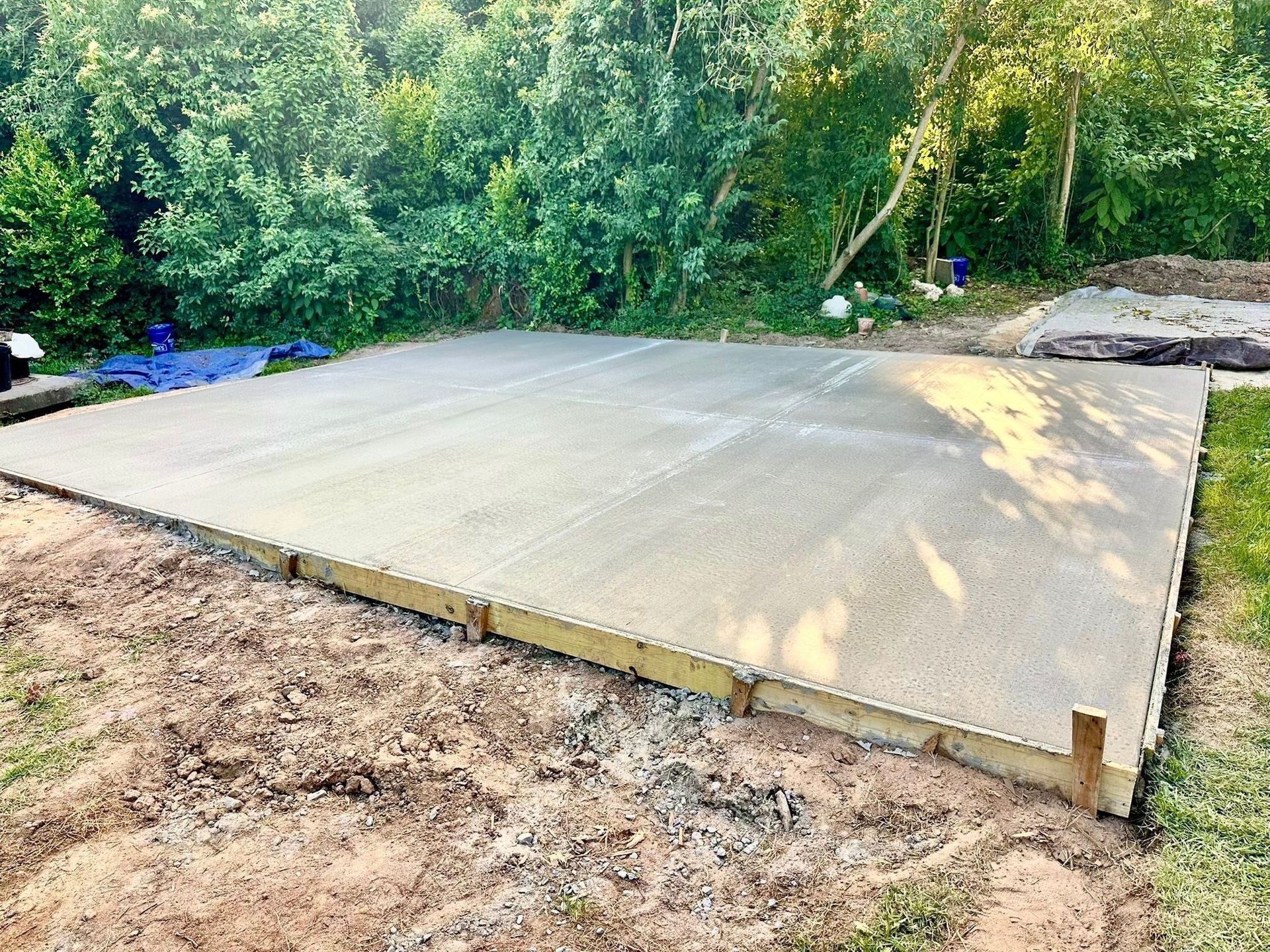
Once the pour is complete and cured, you will notice a consistent surface finish without low spots that collect standing water, clean form edges along the perimeter, and a visible cross-slope that directs runoff away from the house or outbuilding. Reinforcement embedded in the slab is not visible after the pour, but it is what keeps the slab from separating if the subgrade shifts beneath it. A finished driveway or pad should sit flush with any adjacent transitions and drain completely after rain rather than holding water at the edges.
When comparing quotes, the line items that distinguish thorough work from a minimum-effort pour are subgrade preparation, base material depth, reinforcement type and spacing, and whether final cleanup and form removal are included. A quote that omits any of those line items is not a lower price for the same work; it is a different scope that shifts those costs and risks to you after the job is complete.
Common Questions About Concrete Work
The following questions address how concrete driveways and flatwork are actually installed, what decisions get made on site, and what finished work looks like on the kinds of properties common in Harlem and across Columbia County.
What does subgrade preparation involve before concrete is poured?
The crew strips organic material, removes soft spots, and compacts the exposed soil in lifts before any base material is placed, because concrete poured over uncompacted ground is subject to differential settling that causes cracking regardless of slab thickness.
How is reinforcement selected for a residential driveway or pad?
Rebar sizing and spacing are matched to the expected load, with heavier reinforcement used for slabs that will carry trucks or equipment rather than passenger vehicles, and wire mesh used only where loads are light and the subgrade is already well-compacted.
What finish options are available for a concrete driveway surface?
Broom finish is the most common for driveways because the texture provides traction, while a smooth trowel finish is used for interior slabs and patios where a cleaner appearance is the priority.
Why does the slope of a slab matter and how is it set?
Slope is established when the forms are set, not after the pour, and a minimum two percent cross-slope is standard for any exterior slab so water drains away from the structure rather than sitting against the foundation or outbuilding wall.
How do older rural lots in Harlem affect the scope of a concrete project?
Parcels outside the subdivisions in Grovetown often have existing vegetation, root systems, and uneven fill that require additional clearing and compacting before the subgrade is ready, which is why site preparation is evaluated on each lot individually rather than quoted as a flat add-on.
V & S Grading also
installs concrete driveways and flatwork in Harlem, Grovetown, Evans, Augusta, Martinez, and Appling. To discuss your driveway or slab project in detail, including what subgrade work your specific lot will require, call V & S Grading at (706) 901-0595 to arrange a site evaluation.