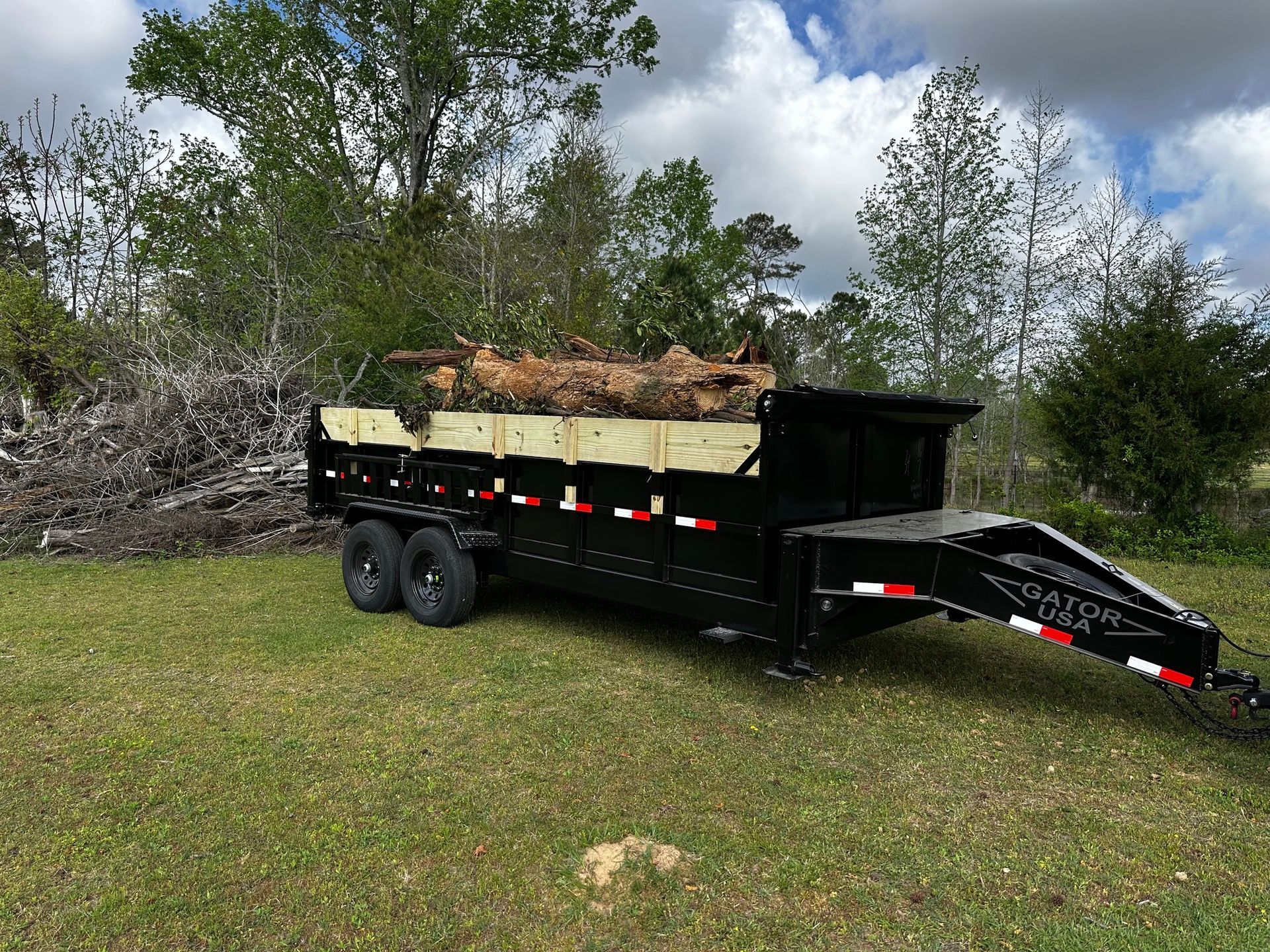
Trees and Brush Removed Before Ground Work Begins
Tree removal in Harlem for older rural parcels where mature trees and overgrowth must come out before grading or building can proceed
Mature trees, overgrown brush, and untouched rural parcels define a large portion of the land in this part of Columbia County, and on most of those properties the trees and vegetation have to come out before any grading, pad, or driveway can be built. V & S Grading handles tree removal and land clearing in Harlem, Georgia and within an hour of the Augusta area. Because land clearing is done in-house by the same owner-operated crew that grades and builds on the cleared ground, the removal sequence is planned with the next phase already in view—not handed off to a separate contractor who leaves a rough, debris-filled surface behind.
The crew surveys the trees and site access before cutting begins, then removes trees in a sequence that protects nearby structures and keeps the cleared area workable as the job progresses. Stumps and brush are cleared after the trees come down, and debris is hauled off the site rather than pushed to a corner. The cleared ground is then available for grading in the same mobilization, which matters when a building pad or driveway is the intended end use.
To discuss what is on your property and what sequence the clearing and grading work should follow, call V & S Grading at (706) 901-0595 to arrange a site visit.
Why Removal Sequence and Stump Clearing Determine What Comes Next
Tree removal on a rural parcel is a sequencing problem as much as a physical one. Large trees near a structure or fence line have to come down in sections and in an order that controls where each section falls, which takes longer than felling open-grown trees but is the only method that does not risk dropping material on what is nearby. The access path for equipment also has to be planned before the first cut, because once trees are on the ground the site changes significantly.
Once clearing is complete and debris is removed, the difference on site is immediate and specific: the ground is open, access is clear, and the condition of the soil surface is visible for the first time. Stumps that were ground or pulled leave depressions that must be filled before grading begins—which is a routine part of the transition from clearing to grading when the same crew handles both phases. Root mass left in place beneath a building pad is one of the leading causes of differential settlement in slab-on-grade construction on rural lots in this area.
Older rural parcels in the Appling and Thomson areas frequently have trees that have been in place long enough to develop root systems that extend well beyond the drip line, which affects both how stumps are removed and how much fill may be needed in the root zone before grading begins. Understanding that relationship between tree removal and the grading phase that follows is what separates a cleared site that is ready to build from one that still has hidden problems beneath the surface.
What Property Owners Ask About Tree Removal and Clearing
The questions below address how tree removal and land clearing actually proceed on the rural and older parcels common in this part of Georgia, and what decisions the crew makes before and during the work.
How does the crew determine the sequence for removing trees near a structure?
Trees are assessed for their fall zone relative to structures, utilities, and other trees, then removed in the order that keeps each successive fall zone clear—typically starting with the tree whose removal opens the most working room for what follows.
Why does stump removal matter if the cleared area is going to be graded anyway?
Stumps and root mass left in place will decay over time and compress unevenly under fill, creating voids that cause settlement in any pad, slab, or driveway built above them; removing or grinding the stump and filling the cavity with compacted material eliminates that failure point.
What happens to debris after the trees and brush are removed?
The crew removes debris from the site rather than burning or pushing it to a boundary, because buried or burned debris creates organic layers in the soil profile that behave unpredictably under load once grading begins.
How does access on older rural parcels in Harlem affect how clearing equipment is brought in?
Many older parcels in this area have limited or overgrown access points, so the crew evaluates gate width, ground bearing capacity along the access path, and overhead clearance for equipment before mobilizing to avoid damaging what is already in place.
When is grading done in the same mobilization as tree removal, and when is it a separate phase?
Grading can follow clearing in the same mobilization when the cleared ground is stable and does not require significant stump fill or soil amendment; when large root systems or deep stump removal leave significant voids, those areas need to be filled and allowed to firm before grading equipment works across them.
V & S Grading also performs
tree removal and land clearing in Dearing, Grovetown, Evans, Augusta, Martinez, and Appling. To talk through what is on your property and how clearing connects to the grading or building phase that follows, call V & S Grading at (706) 901-0595.