
Concrete Surfaces Poured on Ground That Will Hold Them
Patios and walkways in Harlem for homes with uneven, sinking, or unprepared ground beneath existing slabs
What changes after a properly poured concrete patio or walkway is installed is straightforward: the surface is stable, drains away from the house, and does not shift or crack from the soil beneath settling. V & S Grading installs concrete patios and walkways in Harlem, Georgia and the surrounding Augusta area, handling every step from ground preparation through the finished pour. Because V & S Grading operates as a small owner-operated crew, the same team that grades and drains the ground beneath the slab is the team that sets forms, pours, and finishes the concrete—so the base work is never handed off or assumed to be adequate.
Older homes in the Evans and Martinez areas frequently have walkways that have sunk or tilted because the soil beneath them was never prepared before the original pour. The fix is not to pour over the existing problem: the area is cleared, the ground is re-graded to the right slope, a compacted gravel base is installed, then forms are set so the finished surface sheds water away from the structure. Joints are cut at standard intervals to control where cracking occurs, keeping the slab intact between those control points.
Request an on-site assessment from V & S Grading to look at the existing ground condition and determine what base preparation your project requires before forms are set.
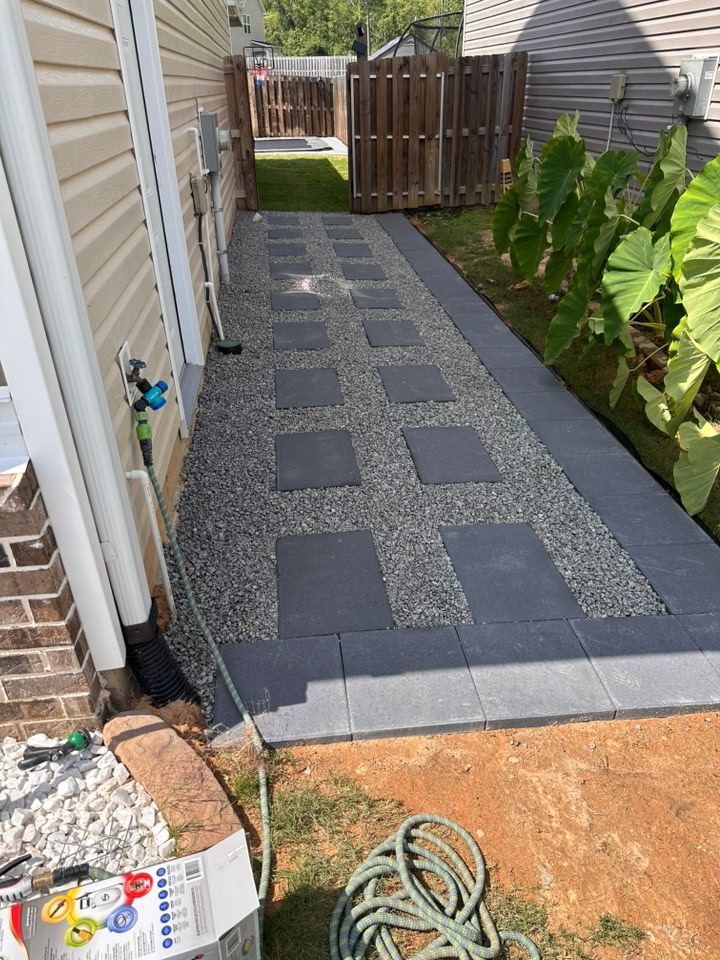
The Difference Between a Poured Slab and a Lasting One
A concrete slab is only as stable as the material it sits on. Gravel base depth, compaction method, and form slope are the three variables that determine whether a patio remains flat or begins to rock and crack within a few years. The gravel layer provides drainage beneath the slab and distributes load across a wider footprint than concrete alone can manage; without it, point loads from furniture or foot traffic concentrate stress in the slab and accelerate cracking.
Once the pour is complete and the concrete has cured, the results are visible and functional: water runs off the edge of the slab in the direction the forms were set, the surface is level across its field, and the control joints are straight and clean. A patio that drains toward the house rather than away from it is one of the most common finishing errors on residential concrete work, and it is a direct result of forms being set at the wrong slope before the pour.
The scope of a concrete patio or walkway project also depends on whether any grading or drainage work is needed beyond the slab footprint. V & S Grading can address those conditions in the same mobilization, which matters on sloped lots where the ground adjacent to the new slab needs to match the finished edge elevation rather than undercut it.
Answers About How the Work Is Done
The questions below address how concrete patio and walkway installation actually proceeds, including what preparation the ground requires and what quality work looks like when it is finished.
Why is a compacted gravel base necessary under a concrete patio?
The gravel base provides a stable, draining layer that prevents the slab from rocking as the soil beneath it shifts or settles, and it distributes the weight of the slab and what is placed on it over a larger area than bare soil can reliably support.
How does the crew set forms to ensure the finished surface drains correctly?
Forms are staked and leveled to a predetermined slope—typically a minimum of one-eighth inch per foot away from the structure—so the concrete poured inside them locks in that drainage direction as it cures.
What are control joints and how are they placed?
Control joints are saw cuts made in the cured slab at planned intervals, typically one to one-and-a-half times the slab thickness in feet, that direct stress fractures to a predictable location so the field of the slab stays intact.
How does the existing condition of the ground in Harlem affect how the base is prepared?
Many older lots in this area have fill placed without formal compaction over the years, so the crew may need to over-excavate and replace that material with compacted gravel rather than simply adding gravel on top of what is there.
How can a property owner check that a finished concrete surface was formed at the right slope?
After the first rain following cure, water should sheet off the slab edge away from the house with no pooling visible at the wall or door threshold; standing water near the structure indicates the forms were set at insufficient or reversed slope.
V & S Grading also installs concrete patios and walkways in Grovetown, Evans, Augusta, Martinez, and Appling. To discuss your property's ground conditions and what your project requires, call V & S Grading at (706) 901-0595.